x <- Sys.Date()
class(x)
#> [1] "Date"24 S3, S4, and S7
You call print(x) and it does the right thing whether x is a number, a data frame, or a linear model. How? R looks at the class of x and picks the right print function. That is dispatch.
24.1 What dispatch means
print(x) isn’t one function. It’s a generic: a function that inspects its input and delegates to a specialized method. print.data.frame, print.Date, print.lm: each is a method. The generic print finds the right one based on class(x).
When you call print(x), R sees that class(x) is "Date", looks for a function named print.Date, and calls it. If no such function exists, R falls back to print.default.
summary(), plot(), mean(), [: all generics. R is full of them. You can list the methods for any generic:
head(methods(print), 10)
#>  [1] "print.acf"               "print.activeConcordance"
#>  [3] "print.AES"               "print.anova"
#>  [5] "print.aov"               "print.aovlist"
#>  [7] "print.ar"                "print.Arima"
#>  [9] "print.arima0"            "print.AsIs"
This is functional OOP: methods belong to generics, not to classes. You call print(x), not x.print(). In Java, Python, or C++, methods belong to objects and you write object.method(). R dispatches on the first argument.
Anyone can add a method for any class to any generic without modifying the class. Package A defines a class, package B defines a method for it, and neither needs to know the other exists.
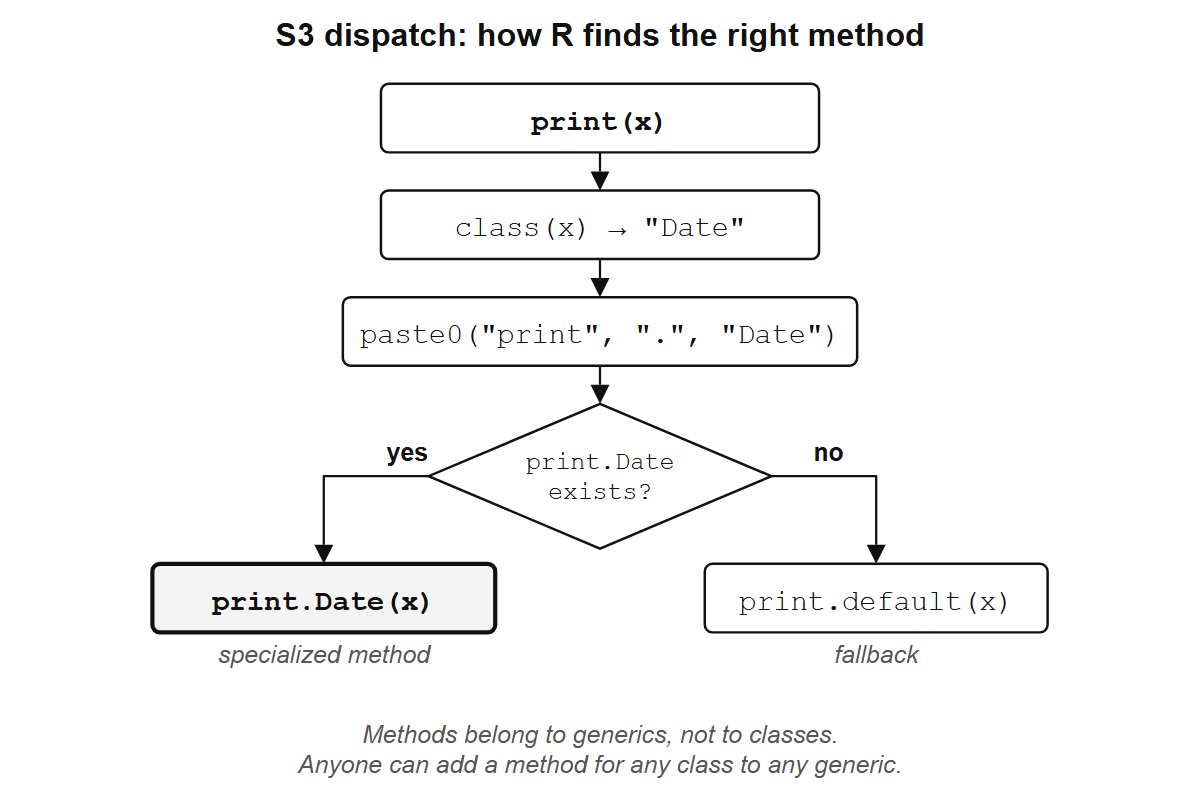
Dispatch is R picking which function to call, the same principle as “everything that happens is a function call” (Section 7.5).
NoteThe type-theory connection
In type theory, the type of an expression determines which reduction rules apply. S3 dispatch is the same idea: the class attribute determines which method runs, and the generic is a polymorphic term whose behavior is resolved at runtime by inspecting the type of its argument. This is ad-hoc polymorphism (different code for different types), as opposed to the parametric polymorphism of Hindley-Milner type systems, where the same code works for all types. R does not have parametric polymorphism in the formal sense, but functions like length() and c() behave parametrically: they work on any vector regardless of element type.
S3 dispatch also connects to sum types. When you give an object a class, you are tagging it as one variant of a type. class(x) = "penguin" says “this object is a penguin, not a dog, not a book.” The generic function then pattern matches on the tag, dispatching to the method for that variant, exactly how sum types work in Haskell (case x of) or Rust (match x): inspect the tag, run the corresponding branch. R’s mechanism is informal (a string attribute instead of a compiler-checked type), but the algebraic structure is the same sum type you saw with factor levels (Section 12.4). The class vector is the tag; UseMethod() is the match.
The difference is exhaustiveness. In Haskell, the compiler verifies before the program runs that every case is handled. In R, you find out at runtime that no method exists for your class, and print.default picks up the slack. Attaching a class string to any object without declaring a type hierarchy first suits interactive work, where data structures evolve faster than formal definitions; the cost is that every missing method surfaces only when someone passes an object you did not anticipate.
24.2 S3 basics
S3 is informal. A class is just a string attached to an object:
x <- structure(list(name = "Adelie", mass = 3750), class = "penguin")
class(x)
#> [1] "penguin"
That’s all it takes: a list (or vector) with a class attribute attached to it.
A generic is a function that calls UseMethod():
greet <- function(x, ...) UseMethod("greet")A method is a function named generic.class:
greet.penguin <- function(x, ...) paste("Hello,", x$name)
greet(x)
#> [1] "Hello, Adelie"
The dispatch path: greet(x) checks class(x), finds "penguin", looks for greet.penguin, calls it. If no method is found, R falls back to greet.default (if you defined one).
You can watch this happen with sloop::s3_dispatch():
sloop::s3_dispatch(greet(x))
#> => greet.penguin
#>    greet.default
The => arrow marks the method that was actually called. The * marks methods that exist but weren’t called. This is useful for debugging inheritance chains (more on that in Section 24.4).
Exercises
- Create an S3 class
"dog"with fieldsnameandbreed(usestructure()and a list). Write aprint.dogmethod that prints something like"Rex (Labrador)". Verify thatprint(your_dog)calls your method. - Write a
greet.defaultmethod that returns"I don't know how to greet this". Test it on a plain list without a class. - Use
sloop::s3_dispatch()to see the dispatch path forprint(Sys.Date()). Which method gets called?
24.3 Writing S3 classes properly
Setting a class with structure() works on anything, including a penguin with a number for a name and a negative mass:
bad <- structure(list(name = 42, mass = -100), class = "penguin")
greet(bad)
#> [1] "Hello, 42"
Every method you write for "penguin" now has to cope with objects like bad, or fail on them. The usual answer is to route construction through three functions. The first creates the object with no checks at all, and is meant for developers:
new_penguin <- function(name, mass) {
  structure(list(name = name, mass = mass), class = "penguin")
}
The second checks that the object makes sense and returns it unchanged if it does:
validate_penguin <- function(x) {
  if (!is.character(x$name) || length(x$name) != 1) {
    stop("`name` must be a single character string")
  }
  if (!is.numeric(x$mass) || length(x$mass) != 1 || x$mass <= 0) {
    stop("`mass` must be a single positive number")
  }
  x
}
The third is the one users call. It runs the first and then the second:
penguin <- function(name, mass) {
  validate_penguin(new_penguin(name, mass))
}
Now the same mistake is caught at the door:
penguin(42, 3750)
#> Error in `validate_penguin()`:
#> ! `name` must be a single character string
Advanced R names the three the constructor, the validator, and the helper: construction is cheap, validation is careful, and the user interface is clean. If you write S3 classes, write all three.
Exercises
- Write the constructor/validator/helper trio for a
"book"class with fieldstitle(character),pages(positive integer), andyear(four-digit number). Test the validator by trying to create a book with -50 pages. - Add a
print.bookmethod that prints something like"Title (Year, N pages)".
24.4 Inheritance
S3 supports single inheritance via class vectors:
emperor <- structure(
  list(name = "Emperor", mass = 23000, dive_depth = 500),
  class = c("diving_penguin", "penguin")
)
class(emperor)
#> [1] "diving_penguin" "penguin"
When you call greet(emperor), R looks for greet.diving_penguin first, then greet.penguin, then greet.default. The class vector is a priority list.
sloop::s3_dispatch(greet(emperor))
#>    greet.diving_penguin
#> => greet.penguin
#>    greet.default
No greet.diving_penguin exists, so R falls through to greet.penguin. You can define a specialized method and use NextMethod() to delegate to the parent:
greet.diving_penguin <- function(x, ...) {
  parent_greeting <- NextMethod()
  paste(parent_greeting, "(dives to", x$dive_depth, "m)")
}
greet(emperor)
#> [1] "Hello, Emperor (dives to 500 m)"
NextMethod() calls the next method in the chain, like super() in Python or Java. The diving penguin method adds dive information to whatever the penguin method already produces.
Keep inheritance shallow. One or two levels is typical in R. Deep hierarchies (five classes deep, overriding methods at every level) are rare and usually a sign you want a different design. If you find yourself building a tree of classes, step back and ask whether composition (storing one object inside another) would be simpler.
Exercises
- Create a
"fiction_book"class that inherits from"book"(from the previous exercise) and adds agenrefield. Write aprint.fiction_bookmethod that usesNextMethod()and appends the genre. - Use
sloop::s3_dispatch()onprint(your_fiction_book)to see the dispatch chain.
24.5 Why S3 works
S3 is R’s dominant OOP system, and the name tells you where it came from. By the early 1990s, S (Section 2.3) had grown a library of statistical models, and every one of them needed print(), summary(), and plot() to do something different. The solution its designers chose was a naming convention: attach a class string to any object, and let the generic function find the right method by pasting the generic name and the class name together. No class registry, no formal type hierarchy, no compiler checks. It arrived in 1992 as part of the third version of S, and the system has been called S3 ever since.
It was supposed to be temporary. By 1998, John Chambers had designed S4, a formal OOP system with typed slots, multiple dispatch, and a class registry enforced by setClass() and setGeneric(). The Bioconductor project adopted S4 for its genomics infrastructure, but the rest of the R community kept using S3. A method for an existing generic can be added by anyone, in any package, without coordination, and that is what a decentralized ecosystem of 20,000+ CRAN packages needs. A class goes on a list in one line, and the first method can follow in the next.
The price is enforcement. Nothing stops you from creating a "penguin" with a numeric name or negative mass, unless you write the validator yourself. S3 trusts the programmer.
TipOpinion
S3 works because R programmers are disciplined. Follow the constructor/validator/helper pattern and you get most of the safety of a formal system with none of the ceremony. Skip the pattern and you get bugs that hide until production.
24.6 S4 in brief
S4 adds formality. setClass() defines a class with typed slots, setGeneric() creates a generic, and setMethod() registers a method:
setClass("Animal",
  slots = list(
    name = "character",
    mass = "numeric"
  )
)

setGeneric("describe", function(x, ...) standardGeneric("describe"))
setMethod("describe", "Animal", function(x, ...) {
  paste(x@name, "weighs", x@mass, "g")
})

a <- new("Animal", name = "Cat", mass = 4500)
a@name
describe(a)
Slots are accessed with @ instead of $. Validation can be built in via the validity argument to setClass().
S4’s distinctive feature is multiple dispatch: setMethod("combine", c("Matrix", "vector"), ...) chooses a method based on the types of both arguments. S3 dispatches on one argument only and has no direct way to say “when type A meets type B, do C.” Multiple dispatch is the more expressive of the two and the harder to reason about, since the method that runs depends on a combination of classes rather than one.
S4 is used extensively in Bioconductor and some base R infrastructure (the Matrix package, the methods package). This book does not teach S4 in depth. If you need it, you will know: Bioconductor work, formal class hierarchies, or extending packages that already use S4. For most R programming, S3 or S7 is the right choice.
24.7 S7
S7 is a CRAN package, designed by the R Consortium’s Object-Oriented Programming Working Group, which includes members of R-Core, Bioconductor, and the tidyverse. Base R has been changing underneath it: R 4.3.0 added two generics, nameOfClass() and chooseOpsMethod(), through which inherits() and the operator group generics consult other object systems, and R 4.4.0 renamed the internal S4 object type to a general one. Each change is credited in R’s NEWS file to the working group and described as support for “experimenting with alternative object systems”. The S7 package itself is still a package, and its stated goal is to be a successor to S3 and S4.
Where S3 keeps its class in a string and S4 keeps it in a registry, S7 builds the whole system out of functions you call, compose, and pass around, the same primitive this book has been building on since Chapter 5. The objects have typed properties and built-in validation, but the machinery that defines classes, creates generics, and dispatches methods is itself just functions. A class comes from new_class():
library(S7)

penguin <- new_class("penguin",
  properties = list(
    name = class_character,
    mass = class_double
  ),
  validator = function(self) {
    if (self@mass <= 0) "mass must be positive"
  }
)

# penguin is now a constructor function:
p <- penguin(name = "Adelie", mass = 3750)
p
#> <penguin>
#>  @ name: chr "Adelie"
#>  @ mass: num 3750
Properties are typed and validated. You access them with @, like S4 slots, but the syntax is cleaner. The validator returns an error message string (or NULL if valid), rather than calling stop().
Generics and methods use new_generic() and method():
greet <- new_generic("greet", "x")
method(greet, penguin) <- function(x, ...) {
  paste("Hello,", x@name)
}

p <- penguin(name = "Adelie", mass = 3750)
p@name
#> [1] "Adelie"
greet(p)
#> [1] "Hello, Adelie"
The constructor penguin(...) was generated for you, with named arguments matching the properties, the validator ran on construction, and each property was checked against its declared type. That is the three-function pattern from Section 24.3, written once by the package instead of once per class. Against S4, the difference is ceremony: no setClass/setGeneric/setMethod triplet, and dispatch that builds on the S3 mechanism everything already uses, so S7 methods can dispatch on S3 classes and S3 methods on S7 classes.
Inheritance uses the parent argument:
diving_penguin <- new_class("diving_penguin",
  parent = penguin,
  properties = list(
    dive_depth = class_double
  )
)

emperor <- diving_penguin(name = "Emperor", mass = 23000, dive_depth = 500)
emperor
#> <diving_penguin>
#>  @ name      : chr "Emperor"
#>  @ mass      : num 23000
#>  @ dive_depth: num 500

greet(emperor)
#> [1] "Hello, Emperor"
# inherited from the penguin method
The child class inherits the parent’s properties and methods. You can override methods for the child class the same way: method(greet, diving_penguin) <- function(x, ...) ....
TipOpinion
For new code, use S7 if you want validated properties and formal structure. Use S3 if you want simplicity and zero dependencies. Both are good choices. S4 is for existing codebases that already use it. Do not start new projects with S4 unless you are writing Bioconductor packages.
Exercises
- Rewrite the
"book"class from the earlier exercise as an S7 class with propertiestitle(character),pages(integer), andyear(integer). Add a validator that checkspages > 0andyear > 0. (You will needlibrary(S7)installed.) - Create an S7 generic
describeand a method for yourbookclass that returns"Title (Year, N pages)". - Create a child class
"ebook"with an additionalformatproperty (character, e.g."epub"or"pdf"). Verify that thedescribemethod is inherited.