Richness Estimation and Completeness
Gilles Colling
2026-10-10
Source:vignettes/richness-estimation.Rmd
richness-estimation.RmdInstallation
install.packages("spacc")            # CRAN

install.packages("pak")              # development version
pak::pak("gcol33/spacc")
Overview
Observed richness is a floor, never the truth. A survey records the species it happens to detect, and the ones with few individuals or few occurrences are the ones most likely to slip through. The deficit shrinks as effort grows, yet it never reaches zero in finite samples. spacc ships a family of non-parametric estimators that read the deficit off the rare end of the frequency distribution and add an estimate of the unseen species to the observed count.
The estimators are non-parametric in the sense that they assume no particular shape for the underlying abundance distribution. Rather than fitting a log-series or log-normal and reading off its tail, they exploit a single structural fact: the species seen once or twice carry almost all the information about the species seen zero times. A community in which many species are singletons is a community that is still discovering new species with every added sample, so its true richness lies well above what has been recorded. A community with no singletons has, in effect, been sampled to saturation, and the observed count is close to the truth.
This vignette treats richness estimation as an algorithmic problem.
It sets out the estimator family and the rare-species logic behind it,
writes the formulas exactly as spacc implements them,
traces how each estimate approaches a known true richness as sampling
effort increases, covers the few tunable parameters, compares the
package estimators against iNEXT on identical data, and
closes with completeness profiles and a block of practical guidance.
Throughout, the data are simulated from a community with a fixed true
number of species, so every estimate can be checked against the number
it is trying to recover.
Algorithm overview
The non-parametric family splits along the kind of data it consumes. Abundance-based estimators work on individual counts pooled across the survey: the input is the total number of individuals of each species. Chao1 and ACE live here. Incidence-based estimators work on occurrence counts: the input is the number of sampling units (sites, plots, traps) at which each species was recorded, ignoring how many individuals were found. Chao2, the first- and second-order jackknives, and the bootstrap live here. The improved estimators iChao1 and iChao2 extend their Chao counterparts, one on each side of the abundance/incidence divide.
The rare-species logic is the same on both sides. Let \(S_{obs}\) be the observed species count. In abundance data, let \(f_k\) be the number of species represented by exactly \(k\) individuals in the pooled sample, so \(f_1\) counts singletons, \(f_2\) doubletons, \(f_3\) tripletons, and \(f_4\) quadrupletons. In incidence data, let \(Q_k\) be the number of species detected in exactly \(k\) sampling units, so \(Q_1\) counts uniques (found at one site), \(Q_2\) duplicates (found at two sites), and so on. The number of sampling units is \(m\). Singletons and uniques are the key quantity. Their abundance answers a Good-Turing question: how much probability mass sits on species not yet seen. Many singletons mean a large unseen pool; zero singletons mean the unseen pool is, to first order, empty.
Chao1 and Chao2 turn that intuition into a minimum-variance lower bound on richness, built from \(f_1, f_2\) (or \(Q_1, Q_2\)) alone. ACE takes a coverage route: it splits species into a rare group and an abundant group at an abundance threshold, estimates the sample coverage of the rare group from its singleton fraction, and inflates the rare count by the inverse of that coverage, with a further correction for how unevenly the rare species are distributed. The jackknife estimators come from resampling theory rather than coverage theory. They ask how the observed count would change if sampling units were deleted one at a time, and extrapolate the resulting bias. The first-order jackknife uses only \(Q_1\); the second-order form adds a \(Q_2\) term. The bootstrap estimator takes yet another route, summing each species’ probability of being missed entirely across all \(m\) units. A species present at half the units contributes a tiny correction, while one present at a single unit contributes most of its weight, so the bootstrap, like the Chao bounds, draws almost all of its correction from the rare end of the occurrence distribution.
The improved estimators address a known weakness of the original Chao bounds. Chao1 and Chao2 use information only up to doubletons, which makes them conservative when a sample is small enough that tripletons and quadrupletons still carry signal. iChao1 and iChao2 add a correction built from \(f_3, f_4\) (respectively \(Q_3, Q_4\)) that raises the estimate when the rare tail is heavy, and that vanishes when \(f_4 = 0\) (respectively \(Q_4 = 0\)), at which point the improved estimator returns exactly its Chao parent. The improved estimators are therefore always at least as large as their standard counterparts, and the gap between them is itself a diagnostic for how far from saturation a sample sits.
All estimators in spacc return a
spacc_estimate object carrying the point estimate, a
standard error, a 95% confidence interval, the observed richness, and
the rare-frequency counts that drove the calculation. The Chao-family
intervals are log-transformed so the lower bound never drops below \(S_{obs}\), which is the correct behaviour
for a quantity that can only be underestimated.
Data setup
The simulated community has a true richness of 120 species. Relative abundances are log-normal, so a few species dominate and a long tail is rare. Eighty sampling units each draw 25 individuals at random, which leaves several true species undetected and many detected only once or twice. The observed richness sits below 120, and the gap is what the estimators must recover.
library(spacc)
set.seed(1)

S_true <- 120
rel <- exp(rnorm(S_true, mean = 0, sd = 1.5))
rel <- rel / sum(rel)

n_sites <- 80
species <- t(sapply(seq_len(n_sites),
                    function(i) rmultinom(1, size = 25, prob = rel)))
species <- species[, colSums(species) > 0, drop = FALSE]  # detected species
colnames(species) <- paste0("sp", seq_len(ncol(species)))
S_obs <- ncol(species)
ab <- colSums(species)
data.frame(S_true = S_true, S_obs = S_obs,
           f1 = sum(ab == 1), f2 = sum(ab == 2),
           f3 = sum(ab == 3), f4 = sum(ab == 4))
#>   S_true S_obs f1 f2 f3 f4
#> 1    120   113 11 15 11  8
The rare-frequency counts confirm the sample is informative but not saturated: several singletons and doubletons feed the Chao bounds, and non-zero tripletons and quadrupletons mean the improved estimators have something to correct.
Non-parametric richness estimators
Each estimator is a one-line call on the site-by-species matrix. Abundance-based estimators pool the columns into total counts; incidence-based estimators binarize first. The print method reports the observed count, the estimate, the standard error, and the interval.
Abundance-based: Chao1 and ACE
chao1(species)
#> Richness Estimator: chao1
#> --------------------------------
#> Observed species (S_obs): 113
#> Estimated richness:       117.0
#> Standard error:           3.0
#> 95% CI:                   [114.1, 127.8]
spacc::ace(species)
#> Richness Estimator: ace
#> --------------------------------
#> Observed species (S_obs): 113
#> Estimated richness:       119.1
#> Standard error:           37.2
#> 95% CI:                   [113.1, 369.8]
Incidence-based: Chao2 and jackknife
chao2(species)
#> Richness Estimator: chao2
#> --------------------------------
#> Observed species (S_obs): 113
#> Estimated richness:       117.0
#> Standard error:           3.3
#> 95% CI:                   [114.0, 129.4]
jackknife(species, order = 1)
#> Richness Estimator: jackknife1
#> --------------------------------
#> Observed species (S_obs): 113
#> Estimated richness:       123.9
#> Standard error:           260.4
#> 95% CI:                   [113.0, 634.2]
jackknife(species, order = 2)
#> Richness Estimator: jackknife2
#> --------------------------------
#> Observed species (S_obs): 113
#> Estimated richness:       120.1
#> Standard error:           7.5
#> 95% CI:                   [113.0, 134.8]
Bootstrap estimator
bootstrap_richness(species, n_boot = 100)
#> Richness Estimator: bootstrap
#> --------------------------------
#> Observed species (S_obs): 113
#> Estimated richness:       119.7
#> Standard error:           3.2
#> 95% CI:                   [113.0, 118.7]
Comparison table
estimators <- list(
  chao1(species), chao2(species), spacc::ace(species),
  jackknife(species, order = 1), jackknife(species, order = 2),
  bootstrap_richness(species, n_boot = 100)
)
tab <- do.call(rbind, lapply(estimators, as.data.frame))
tab$gap_to_truth <- S_true - tab$estimate
tab
#>    estimator S_obs estimate         se    lower    upper gap_to_truth
#> 1      chao1   113 117.0333   3.002789 114.0975 127.8232    2.9666667
#> 2      chao2   113 116.9829   3.287717 113.9696 129.3604    3.0170833
#> 3        ace   113 119.1117  37.166285 113.1455 369.7607    0.8882910
#> 4 jackknife1   113 123.8625 260.367721 113.0000 634.1832   -3.8625000
#> 5 jackknife2   113 120.1476   7.470878 113.0000 134.7905   -0.1476266
#> 6  bootstrap   113 119.7154   3.345286 113.0000 117.6051    0.2846335
Every estimate lies above the observed count and below or near the true 120. The bootstrap and the bias-corrected Chao bounds sit lowest, the jackknives highest, which matches the textbook ordering for a moderately under-sampled community.
Mathematical detail
The formulas below are the ones spacc evaluates,
read directly from R/estimators.R. Symbols are as defined
above: \(S_{obs}\) observed richness,
\(f_k\) abundance frequency counts,
\(Q_k\) incidence frequency counts, and
\(m\) the number of sampling units.
Chao1
When at least one doubleton is present, Chao1 uses the classic ratio of squared singletons to doubletons:
\[ S_{Chao1} = S_{obs} + \frac{f_1^2}{2 f_2}, \qquad f_2 > 0 . \]
When \(f_2 = 0\) the ratio is undefined and spacc switches to the bias-corrected form, which replaces the doubleton denominator with a count-based expression:
\[ S_{Chao1} = S_{obs} + \frac{f_1 (f_1 - 1)}{2}, \qquad f_2 = 0 . \]
The variance follows Chao (1987). With \(f_2 > 0\),
\[ \widehat{\mathrm{var}} = f_2 \left[ \frac{1}{4}\left(\frac{f_1}{f_2}\right)^2 + \left(\frac{f_1}{f_2}\right)^3 + \frac{1}{4}\left(\frac{f_1}{f_2}\right)^4 \right] , \]
and the standard error is its square root. The confidence interval is log-transformed about \(T = S_{Chao1} - S_{obs}\) so that the lower bound stays at or above \(S_{obs}\).
Chao2
Chao2 is the incidence analogue. It replaces individual frequencies with occurrence frequencies and carries a finite-sample factor \((m-1)/m\):
\[ S_{Chao2} = S_{obs} + \frac{m-1}{m}\,\frac{Q_1^2}{2 Q_2}, \qquad Q_2 > 0 . \]
When \(Q_2 = 0\) the same correction structure as Chao1 applies, again scaled by \((m-1)/m\):
\[ S_{Chao2} = S_{obs} + \frac{m-1}{m}\,\frac{Q_1 (Q_1 - 1)}{2}, \qquad Q_2 = 0 . \]
The factor \((m-1)/m\) tends to one as the number of sampling units grows, so the correction matters most when \(m\) is small.
ACE
ACE partitions the species into a rare group, those with pooled
abundance at most the threshold \(\tau\) (the threshold
argument, default 10), and an abundant group above it. Let \(S_{rare}\) and \(S_{abund}\) be the counts in each group,
\(n_{rare}\) the total individuals in
the rare group, and \(f_1\) the
singletons. The sample coverage of the rare group is
\[ C_{ACE} = 1 - \frac{f_1}{n_{rare}} , \]
and the squared coefficient of variation of the rare abundances is
\[ \gamma^2 = \max\left( \frac{S_{rare}}{C_{ACE}} \frac{\sum_{i=1}^{\tau} i(i-1)\, f_i}{n_{rare}(n_{rare} - 1)} - 1,\; 0 \right) . \]
The estimate combines the abundant count, the coverage-inflated rare count, and a heterogeneity term:
\[ S_{ACE} = S_{abund} + \frac{S_{rare}}{C_{ACE}} + \frac{f_1}{C_{ACE}}\, \gamma^2 . \]
When no species fall in the rare group, ACE returns \(S_{obs}\) unchanged. When the rare group is all singletons, \(C_{ACE} \le 0\) and spacc falls back to the Chao1 bias-corrected form.
Jackknife
The first-order jackknife adds a single \(Q_1\) term scaled by \((m-1)/m\):
\[ S_{jack1} = S_{obs} + Q_1 \frac{m-1}{m} . \]
The second-order jackknife adds a \(Q_2\) term and inflates the \(Q_1\) weight:
\[ S_{jack2} = S_{obs} + \frac{Q_1 (2m - 3)}{m} - \frac{Q_2 (m - 2)^2}{m(m - 1)} . \]
The jackknives are first- and second-order approximations to the bias of \(S_{obs}\), and the second-order form corrects for curvature that the first misses. The intervals are symmetric Gaussian bands truncated at \(S_{obs}\) from below.
Bootstrap
The bootstrap estimator sums each species’ probability of being absent from all \(m\) units. With \(p_i = Q_i / m\) the proportion of units occupied by species \(i\),
\[ S_{boot} = S_{obs} + \sum_{i=1}^{S_{obs}} (1 - p_i)^{m} . \]
The standard error and interval come from n_boot
resamples of the units (default 200), so they are empirical rather than
analytic.
iChao1 and iChao2
The improved estimators (Chiu et al. 2014) add a correction built from the next two frequency counts. For iChao1, with \(f_4 > 0\) and \(f_3 > 0\),
\[ S_{iChao1} = S_{Chao1} + \frac{f_3}{4 f_4} \max\!\left( f_1 - \frac{f_2 f_3}{2 f_4},\; 0 \right) . \]
For iChao2 the incidence quantities take over,
\[ S_{iChao2} = S_{Chao2} + \frac{Q_3}{4 Q_4} \max\!\left( Q_1 - \frac{Q_2 Q_3}{2 Q_4},\; 0 \right) . \]
When \(f_4 = 0\) (respectively \(Q_4 = 0\)) the correction term is dropped and the improved estimator returns exactly its Chao parent. The \(\max(\cdot, 0)\) guard keeps the correction non-negative, which is why the improved estimates are always at least as large as the standard ones.
r_ichao1 <- iChao1(species)
r_ichao2 <- iChao2(species)
r_ichao1
#> Richness Estimator: iChao1
#> --------------------------------
#> Observed species (S_obs): 113
#> Estimated richness:       117.3
#> Standard error:           3.3
#> 95% CI:                   [114.1, 129.5]
r_ichao2
#> Richness Estimator: iChao2
#> --------------------------------
#> Observed species (S_obs): 113
#> Estimated richness:       117.0
#> Standard error:           3.9
#> 95% CI:                   [113.8, 132.6]
ich <- rbind(
  as.data.frame(chao1(species)), as.data.frame(r_ichao1),
  as.data.frame(chao2(species)), as.data.frame(r_ichao2)
)
ich$gap_to_truth <- S_true - ich$estimate
ich
#>   estimator S_obs estimate       se    lower    upper gap_to_truth
#> 1     chao1   113 117.0333 3.002789 114.0975 127.8232     2.966667
#> 2    iChao1   113 117.2697 3.339807 114.1022 129.5398     2.730339
#> 3     chao2   113 116.9829 3.287717 113.9696 129.3604     3.017083
#> 4    iChao2   113 116.9829 3.854043 113.8096 132.5952     3.017083
The improved estimates exceed their standard counterparts by a small margin here, which is consistent with a sample that is close to but not at saturation. A large iChao-minus-Chao gap would flag a heavy rare tail and a sample far from complete.
Accumulation rate curve (ARC)
The ARC estimator (Shestopaloff 2025) uses more of the frequency counts than the Chao family. Drawing the \(N\) observations of the species seen at most \(K\) times (default 20) in random order, the expected number of these species seen after \(n\) draws is
\[ S(n) = \sum_{k=1}^{K} f_k \left[ 1 - \left(1 - \frac{n}{N}\right)^{k} \right] , \]
and its increments \(s_n = S(n) - S(n-1)\) are the rate at which new species appear. Three decay curves, log-normal, log-logistic and Weibull, are fitted to the tail of \(s_n\); the integral of each beyond \(N\) is its count of undetected species. The estimate combines them with weights that minimise the misfit to \(s_n\) plus a penalty on using the log-logistic and Weibull together, each weight bounded by caps built from the three estimates and \(S_{obs}\), and averages over fits to the last 100 down to 70 percent of the curve.
r_arc <- arc(species, n_boot = 0)
r_arc
#> Richness Estimator: ARC
#> --------------------------------
#> Observed species (S_obs): 113
#> Estimated richness:       122.1
#> Standard error:           NA
#> 95% CI:                   [NA, NA]
r_arc$details$undetected
#>   lognormal loglogistic     weibull
#>    9.501777   21.039103    5.819697
r_arc$details$weights
#>   lognormal loglogistic     weibull
#>   0.9294882   0.0000000   0.0475043
The Weibull decays fastest and gives the fewest undetected species,
the log-logistic slowest and the most. The estimate is close to the true
120. The interval comes from a parametric bootstrap of the frequency
counts, which refits the curves n_boot times (default
2000):
With this seed the interval is [116.1, 142.3] around 122.1.
data = "incidence" runs the same estimator on the number of
sites each species occupies.
On 40 samples of 1000 species with Poisson counts and Gamma-mixture rates (the scenarios of Shestopaloff 2025, from sparse to dense), the relative bias and RMSE are:
| Gamma mixture | \(S_{obs}\) | ARC bias | ARC RMSE | iChao1 bias | iChao1 RMSE |
|---|---|---|---|---|---|
| 1.0 / 0 / 0 / 0 | 333 | +0.9% | 0.178 | -24.6% | 0.258 |
| 0.6 / 0.4 / 0 / 0 | 401 | -9.4% | 0.130 | -24.8% | 0.253 |
| 0.2 / 0.8 / 0 / 0 | 466 | -12.7% | 0.166 | -20.7% | 0.219 |
| 0 / 1 / 0 / 0 | 501 | -17.0% | 0.169 | -21.2% | 0.203 |
| 0 / 0.4 / 0.6 / 0 | 649 | +2.9% | 0.061 | -10.9% | 0.115 |
| 0 / 0 / 0.6 / 0.4 | 802 | +1.1% | 0.044 | -3.4% | 0.045 |
The mixture weights are those of Gamma(1, 2), Gamma(1, 1), Gamma(2,
1) and Gamma(3, 1). ARC has the lower RMSE in every row but the densest,
where the two are equal, and by a wide margin in sparse samples. The
author’s reference code reaches lower bias in the middle rows (between
-1.1% and +3.5%) because its optimiser stops at the caps of the
log-normal and log-logistic weights rather than at the minimum of the
weighted loss; arc() returns that minimum, which puts more
weight on the Weibull there.
Behaviour with sample size
The defining property of a useful richness estimator is that it climbs toward the truth as effort grows while its standard error shrinks. The check is direct: subsample rows of the matrix at increasing intensities, recompute the estimate, and average over replicate subsamples to smooth the sampling noise. Here Chao1 is tracked across eight effort levels, thirty replicates each.
effort <- c(10, 20, 30, 40, 50, 60, 70, 80)
conv <- do.call(rbind, lapply(effort, function(k) {
  reps <- t(vapply(1:30, function(r) {
    e <- chao1(species[sample(nrow(species), k), , drop = FALSE])
    c(e$S_obs, e$estimate, e$se)
  }, numeric(3)))
  data.frame(sites = k, S_obs = mean(reps[, 1]),
             estimate = mean(reps[, 2]), se = mean(reps[, 3]))
}))
round(conv, 1)
#>   sites S_obs estimate   se
#> 1    10  68.2     99.2 15.5
#> 2    20  87.1    109.3 11.3
#> 3    30  95.9    117.1 10.9
#> 4    40 102.2    119.5  9.3
#> 5    50 106.0    118.2  6.9
#> 6    60 109.1    118.6  5.8
#> 7    70 111.3    117.5  4.1
#> 8    80 113.0    117.0  3.0
The observed count rises steeply and never catches the truth. The Chao1 estimate overshoots a little at low effort, where singleton noise dominates, then settles toward 120 from above as more units accumulate. The standard error falls monotonically across the eight levels, so the estimate becomes both more accurate and more precise with effort.
library(ggplot2)
ggplot(conv, aes(sites)) +
  geom_ribbon(aes(ymin = estimate - se, ymax = estimate + se),
              fill = "#4CAF50", alpha = 0.2) +
  geom_line(aes(y = estimate), color = "#4CAF50", linewidth = 1) +
  geom_line(aes(y = S_obs), color = "#78909C", linewidth = 1) +
  geom_hline(yintercept = S_true, linetype = "dashed") +
  labs(x = "Sampling units", y = "Richness",
       title = "Chao1 estimate (green) and observed count (grey) vs effort") +
  theme_minimal(base_size = 17) +
  theme(panel.background = element_rect(fill = "transparent"),
        plot.background = element_rect(fill = "transparent"))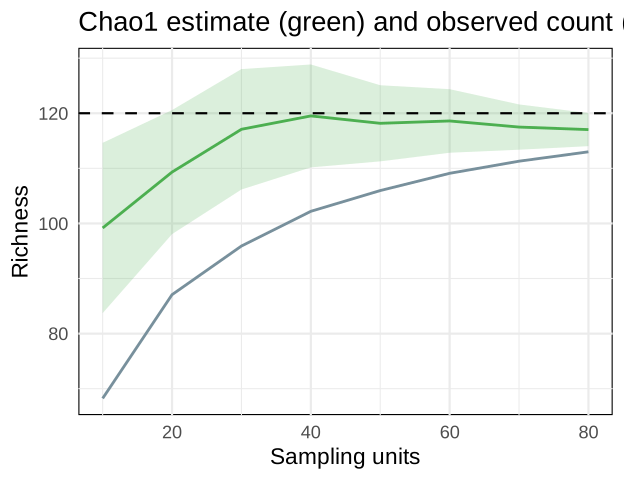
The dashed line marks the true 120. The green band is the Chao1 estimate plus or minus one standard error; the grey line is the observed count. The gap between grey and dashed is the deficit the estimator exists to close, and the green band closes most of it by the time half the units are in.
Tuning
Most of the estimators have no free parameters: Chao1, Chao2, iChao1, and iChao2 are determined entirely by the frequency counts. Three estimators expose a knob.
The ACE threshold \(\tau\)
(threshold, default 10) sets the abundance boundary between
the rare and abundant groups. Only the rare group contributes to the
coverage and heterogeneity correction, so \(\tau\) controls how much of the
distribution ACE treats as informative about unseen species. The default
of 10 follows Chao & Lee (1992) and works for most samples. Raising
it pulls more moderately common species into the rare group, which can
stabilise the estimate when the rare group is otherwise tiny, at the
cost of diluting the singleton signal. Lowering it sharpens the focus on
the rarest species but can leave too few rare individuals for \(C_{ACE}\) to be stable.
do.call(rbind, lapply(c(5, 10, 15, 20), function(th) {
  e <- spacc::ace(species, threshold = th)
  data.frame(threshold = th, estimate = round(e$estimate, 1),
             se = round(e$se, 1))
}))
#>   threshold estimate   se
#> 1         5    117.7 19.8
#> 2        10    119.1 37.2
#> 3        15    120.0 65.5
#> 4        20    120.7 80.3
The jackknife order chooses between bias corrections. The first order
uses \(Q_1\) alone and tends to
under-correct in heterogeneous communities; the second adds a \(Q_2\) term and corrects more aggressively,
at the price of higher variance. The package default is
order = 1. A common selection rule moves to
order = 2 when the first-order estimate still sits far
below a more information-hungry estimator such as Chao2 or iChao2,
signalling residual bias that the extra term can absorb.
The bootstrap n_boot (default 200) sets the number of
unit resamples behind the standard error and the percentile interval.
The point estimate is the closed-form sum above and does not change with
it. Small values such as 50 give a noisy interval; values of 200 or more
give a stable one. The vignette uses 100 to keep build time short, which
is adequate for illustration but light for a reported analysis.
set.seed(7)
do.call(rbind, lapply(c(50, 100, 500), function(nb) {
  e <- bootstrap_richness(species, n_boot = nb)
  data.frame(n_boot = nb, estimate = round(e$estimate, 1),
             se = round(e$se, 2))
}))
#>   n_boot estimate   se
#> 1     50    119.7 3.48
#> 2    100    119.7 2.88
#> 3    500    119.7 3.10
The point estimate is identical across n_boot,
confirming that the knob touches only the uncertainty, while the
standard error settles as the resample count rises.
Comparison to alternatives
iNEXT is the standard reference implementation for
asymptotic richness. Its ChaoRichness() computes the same
Chao1 lower bound on pooled abundance data, so it offers a clean
cross-check on identical input. The agreement table places the
spacc Chao1 alongside the iNEXT estimate
and the true richness.
cr <- iNEXT::ChaoRichness(as.numeric(colSums(species)), datatype = "abundance")
sp_c1 <- chao1(species)
data.frame(
  source = c("spacc::chao1", "iNEXT::ChaoRichness", "truth"),
  estimate = round(c(sp_c1$estimate, cr[["Estimator"]], S_true), 2),
  se = round(c(sp_c1$se, cr[["Est_s.e."]], NA), 2)
)
The two Chao1 implementations agree to the displayed precision, which is the expected result for the same estimator on the same counts. Any residual difference would trace to interval conventions rather than the point estimate. Both land below the true 120, the conservative-by-design behaviour of a lower bound on a moderately incomplete sample.
Sample completeness profile
Richness is the diversity order \(q =
0\), where every species counts equally and the rare tail
dominates. completenessProfile() extends the completeness
idea across the Hill spectrum, reporting the ratio of observed to
estimated diversity at each order:
\[ C_q = \frac{D_q^{obs}}{D_q^{est}} , \]
where \(D_q^{obs}\) is the observed Hill number of order \(q\) and \(D_q^{est}\) its estimated asymptote. Completeness near one means the sample captures most of the true diversity at that order.
cp <- completenessProfile(species)
cp
#> Sample Completeness Profile: 80 sites, 113 species
#> ----------------------------------------
#>    q observed estimated completeness
#>  0.0   113.00    117.03        0.966
#>  0.2    95.34     98.84        0.965
#>  0.4    80.51     83.47        0.965
#>  0.6    68.27     70.49        0.969
#>  0.8    58.28     59.53        0.979
#>  1.0    50.20     50.28        0.998
#>  1.2    43.68     44.84        0.974
#>  1.4    38.43     39.99        0.961
#>  1.6    34.20     35.67        0.959
#>  1.8    30.77     31.82        0.967
#>  2.0    27.99     28.38        0.986
plot(cp) +
  theme(panel.background = element_rect(fill = "transparent"),
        plot.background = element_rect(fill = "transparent"))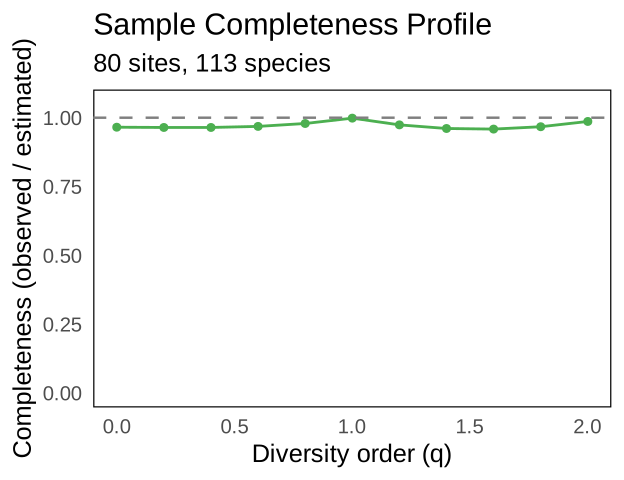
Completeness is lowest at \(q = 0\), where undetected rare species bite hardest, and rises toward one as \(q\) increases and common species, which are detected early, take over the weighting. The profile is a compact summary of which part of the diversity spectrum a sample resolves well: the high-\(q\) end here is nearly complete, while the richness end carries the residual deficit that the non-parametric estimators try to fill. A flat profile near one across all orders would mean the survey is essentially complete; a profile that sags only at low \(q\), as here, localises the incompleteness to the rare species and points to the \(q = 0\) estimators as the ones that still have work to do.
Practical guidance
The choice of estimator depends on the data type and the rare tail. The rules below use specific frequency counts rather than adjectives.
Use an abundance-based estimator (Chao1, ACE, iChao1) when individual counts are trustworthy and pooling them is meaningful. Use an incidence-based estimator (Chao2, jackknife, bootstrap, iChao2) when only presence or absence per unit is reliable, which covers most plot, transect, and trap surveys. Reach for the improved estimators iChao1 or iChao2 whenever \(f_3, f_4 > 0\) (respectively \(Q_3, Q_4 > 0\)): the rare tail still carries signal, and the standard Chao bound will be conservative. When \(f_4 = 0\), iChao1 returns Chao1, so there is nothing to gain by switching.
Three rules of thumb with numbers:
- With \(f_2 = 0\) (no doubletons), the standard Chao1 ratio is undefined and spacc uses the bias-corrected form. Treat any estimate from a \(f_2 = 0\) sample as a soft lower bound only, since a single observed doubleton can move it substantially.
- Aim for at least 20 sampling units before trusting an incidence estimator. The \((m-1)/m\) factor in Chao2 and the bias terms in the jackknives are unstable when \(m\) is in single digits, and the convergence table above shows the estimate still drifting below \(m = 30\).
- When the iChao-minus-Chao gap exceeds roughly 10% of \(S_{obs}\), read it as a warning that the sample is far from saturation and the point estimate is a weak lower bound; collect more data rather than report a single number.
When estimates are unreliable: a sample with \(f_1 \approx S_{obs}\) (almost every species a singleton) gives an enormous, badly determined Chao1 estimate with a standard error of the same order as the estimate itself, as the ACE row in the comparison table illustrates. The jackknives inflate without bound in that regime. The honest report there is the observed count plus a statement that the community is under-sampled, not a precise-looking estimate.
data.frame(
  data_type = c("abundance", "abundance", "abundance",
                "incidence", "incidence", "incidence"),
  estimator = c("chao1", "ace", "iChao1",
                "chao2", "jackknife", "iChao2"),
  use_when = c("counts reliable, f2 > 0",
               "many rare species, heterogeneous",
               "f3, f4 > 0, sample incomplete",
               "presence/absence, m >= 20",
               "incidence, simple bias correction",
               "Q3, Q4 > 0, sample incomplete"),
  unreliable_when = c("f2 = 0", "C_ace <= 0 (all singletons)", "f4 = 0",
                      "Q2 = 0 or m < 10", "few units", "Q4 = 0")
)
#>   data_type estimator                          use_when
#> 1 abundance     chao1           counts reliable, f2 > 0
#> 2 abundance       ace  many rare species, heterogeneous
#> 3 abundance    iChao1     f3, f4 > 0, sample incomplete
#> 4 incidence     chao2         presence/absence, m >= 20
#> 5 incidence jackknife incidence, simple bias correction
#> 6 incidence    iChao2     Q3, Q4 > 0, sample incomplete
#>               unreliable_when
#> 1                      f2 = 0
#> 2 C_ace <= 0 (all singletons)
#> 3                      f4 = 0
#> 4            Q2 = 0 or m < 10
#> 5                   few units
#> 6                      Q4 = 0
Minimum-sample guidance follows the same logic. Abundance estimators need enough total individuals that singletons and doubletons are countable, on the order of a few hundred for a community of dozens of species. Incidence estimators need on the order of 20 or more sampling units before the finite-sample corrections settle. Below those thresholds the estimators still return a number, but the number is governed by sampling noise in \(f_1\) or \(Q_1\) rather than by the structure of the community.
References
- Burnham, K.P. & Overton, W.S. (1978). Estimation of the size of a closed population when capture probabilities vary among animals. Biometrika, 65, 625-633.
- Chao, A. (1984). Nonparametric estimation of the number of classes in a population. Scandinavian Journal of Statistics, 11, 265-270.
- Chao, A. (1987). Estimating the population size for capture-recapture data with unequal catchability. Biometrics, 43, 783-791.
- Chao, A. & Lee, S.M. (1992). Estimating the number of classes via sample coverage. Journal of the American Statistical Association, 87, 210-217.
- Chao, A. & Jost, L. (2012). Coverage-based rarefaction and extrapolation: standardizing samples by completeness rather than size. Ecology, 93, 2533-2547.
- Chiu, C.H., Wang, Y.T., Walther, B.A. & Chao, A. (2014). An improved nonparametric lower bound of species richness via a modified Good-Turing frequency formula. Biometrics, 70, 671-682.
- Shestopaloff, K. (2025). An accumulation rate curve estimator for total species. Environmental and Ecological Statistics, 32, 311-345.
- Smith, E.P. & van Belle, G. (1984). Nonparametric estimation of species richness. Biometrics, 40, 119-129.