Rarefaction and Standardization
Gilles Colling
2026-10-10
Source:vignettes/rarefaction-standardization.Rmd
rarefaction-standardization.RmdInstallation
install.packages("spacc")            # CRAN

install.packages("pak")              # development version
pak::pak("gcol33/spacc")
Introduction
Species richness counted from raw data confounds two things: how diverse a community is and how hard it was sampled. A plot visited for an afternoon yields fewer species than the same plot visited for a week, even though the underlying community has not changed. The same effect appears across sites. A site with 500 recorded individuals will, on average, show more species than a neighbour with 50, because more individuals expose more of the rare tail of the community. Any comparison of raw counts therefore partly measures effort rather than ecology.
The bias is large. Richness rises steeply with the first few dozen individuals and only flattens once the common species are saturated and new records start repeating species already seen. Two sites at different points on that rising curve are not comparable. Reporting that site A has 18 species and site B has 11 says little until both numbers refer to the same amount of sampling.
Standardization removes the effort axis so that the diversity axis can be read on its own. Two families of methods do this. Rarefaction fixes a common sample size and asks how many species would be expected at that size. Coverage-based methods fix a common completeness, the fraction of total community abundance that the observed species account for, and compare richness at that shared completeness. This vignette develops both, shows the estimators spacc provides for each, and ends with concrete rules for choosing between them. The running theme is that the standardization target, equal size or equal coverage, can change which site looks more diverse.
The distinction matters because size and coverage are not interchangeable. A fixed number of individuals corresponds to very different completeness depending on how even the community is. In an even community a few hundred individuals already capture almost every species, so coverage is high. In a community with a handful of dominants and a long tail of rare species, the same few hundred individuals leave much of the tail undetected, so coverage stays low. Comparing two such communities at equal sample size therefore compares them at unequal completeness, which reintroduces a version of the bias that rarefaction was meant to remove. Coverage-based standardization closes that gap by making completeness itself the common currency.
The cost of coverage standardization is that it needs counts of individuals. The singleton and doubleton frequencies that drive the coverage estimate exist only in abundance data, not in presence/absence records. When the data are binary, or when effort varies through the number of plots rather than the number of individuals within a plot, the sample-based rarefaction family is the right tool instead. spacc carries all three families, and the sections below show how to move between them on a single simulated dataset where the true community is known.
Methods and theory
Individual-based rarefaction
Individual-based rarefaction asks a counterfactual question. Given a pooled sample of \(N\) individuals containing \(S_{obs}\) species, how many species would be expected in a random subsample of \(n \le N\) individuals drawn without replacement. Hurlbert (1971) gives the exact expectation. Let \(N_i\) be the total abundance of species \(i\), so that \(N = \sum_i N_i\). The probability that species \(i\) appears at least once in a subsample of \(n\) is one minus the probability of drawing \(n\) individuals that all avoid species \(i\):
\[ P(\text{species } i \in \text{subsample}) = 1 - \frac{\binom{N - N_i}{n}}{\binom{N}{n}}. \]
Summing detection probabilities over all observed species gives the expected rarefied richness, since the expectation of a sum of indicators is the sum of their probabilities:
\[ E[S_n] = \sum_{i=1}^{S_{obs}} \left[ 1 - \frac{\binom{N - N_i}{n}}{\binom{N}{n}} \right]. \]
Here \(E[S_n]\) is expected richness at subsample size \(n\), \(N\) is the total number of individuals pooled across the sites being compared, \(N_i\) is the abundance of species \(i\), and \(S_{obs}\) is the number of species observed in the full pooled sample. The curve \(E[S_n]\) starts at 1 when \(n = 1\), rises monotonically, and reaches \(S_{obs}\) exactly when \(n = N\). The formula is computed on a log scale in spacc to avoid overflow in the binomial coefficients.
The expectation is exact, not a simulation average. Drawing many random subsamples of size \(n\) and averaging their richness would converge to \(E[S_n]\), but the Hurlbert formula gives that limit in closed form, which is both faster and free of Monte Carlo noise. The shape of the curve carries information of its own. A curve that has flattened by \(n = N/2\) indicates a community whose common species are saturated, so doubling the remaining effort would add few species. A curve still rising steeply at \(n = N\) indicates an undersampled community where the species total is an underestimate. spacc attaches a bootstrap interval to the curve by resampling individuals with replacement and recomputing the expectation, which captures sampling variation in the underlying frequencies.
The same logic extends to Hill numbers of order \(q\), which weight species by abundance. Order \(q = 0\) is richness, where all species count equally and the rare tail dominates. Order \(q = 1\) is the exponential of Shannon entropy, which weights species by their frequency. Order \(q = 2\) is the inverse Simpson concentration, dominated by the common species. The Hill number of order \(q\) of a community with relative abundances \(p_i\) is
\[ {}^{q}D = \left( \sum_{i=1}^{S} p_i^{q} \right)^{1/(1-q)}, \qquad q \ne 1, \]
with the \(q = 1\) case taken as the limit \({}^{1}D = \exp(-\sum_i p_i \log p_i)\). Each \({}^{q}D\) is an effective number of species, the count of equally abundant species that would give the same diversity value. Higher \(q\) down-weights rare species, so the rarefaction curve for \(q = 2\) saturates faster and is far less sensitive to subsample size than the curve for \(q = 0\).
The choice of \(q\) encodes a research question rather than a technical preference. Richness (\(q = 0\)) treats a species seen once and a species seen a thousand times as equal contributions, which makes it the most sensitive to sampling effort and to the rare tail. Shannon diversity (\(q = 1\)) weights each species by its abundance, giving a balanced summary that is less affected by the few rarest records. Inverse Simpson (\(q = 2\)) is governed almost entirely by the common species and barely moves as effort grows, which makes it a stable comparison when the rare tail is suspected to be noise. Scanning \(q\) from 0 upward across the same data traces a diversity profile, and the steepness of that profile is itself a measure of how uneven the community is.
Sample coverage
Sample size is a poor common currency when communities differ in evenness. A fixed number of individuals can represent a near-complete census of an even community yet barely scratch a community with a long rare tail. Sample coverage measures completeness directly. Coverage \(C\) is the fraction of the total community abundance belonging to the species already observed, so \(1 - C\) is the probability that the next individual sampled belongs to a species not yet recorded. Chao and Jost (2012) estimate it from the frequency counts of the sample:
\[ C = 1 - \frac{f_1}{N} \cdot \frac{(N-1) f_1}{(N-1) f_1 + 2 f_2}. \]
Here \(f_1\) is the number of singletons, species represented by exactly one individual in the pooled sample, \(f_2\) is the number of doubletons, species represented by exactly two individuals, and \(N\) is the total number of individuals. The estimator rests on the Good-Turing insight that singletons carry the signal about undetected species: many singletons relative to doubletons means the rare tail is poorly sampled and coverage is low. When \(f_1 = 0\) every observed species has been seen more than once, the correction vanishes, and \(C = 1\). Coverage-based rarefaction interpolates richness or any \({}^{q}D\) to a target coverage rather than a target sample size, so two communities are compared at equal proportional representation.
The deficit \(1 - C\) has a direct
reading as a probability. It estimates the chance that the next
individual sampled belongs to a species not yet on the list, so it
answers the practical question of how much new information one more
sample would bring. A deficit of 0.05 means coverage of 0.95, and the
next individual has roughly a one-in-twenty chance of being a new
species. This interpretation is what makes coverage a fair common
currency: two samples at the same deficit have the same residual
probability of discovery, regardless of how many individuals each took
to reach that point. For plot-based spatial data, where the sampling
unit is a site rather than an individual, the Chiu (2023) variant uses
incidence frequencies, the counts of species found in exactly one or two
sites, and is the more appropriate estimator.
spaccCoverage() exposes both through its
coverage argument.
Simulating uneven effort
The simulation idiom from the package, a site-by-species matrix of Poisson abundances, makes the effort bias concrete because the ground truth is known. Here every site is drawn from the same 20-species pool, so the true per-site richness ceiling is identical across all sites. What differs is the Poisson rate, which sets per-site total abundance. Low-rate sites are sampled shallowly and will miss species purely because few individuals were drawn.
Building the matrix this way separates the two things real data conflate. The biological signal, the species pool, is held fixed at 20 species for every site. The sampling signal, the per-site rate \(\lambda\), is varied deliberately across three tiers. Any difference in observed richness between tiers is therefore attributable to effort alone, because the generating community is identical. This is the controlled setting in which a standardization method can be checked: a method that works should erase the between-tier difference, recovering the shared 20-species ceiling, while a method that fails will leave the effort gradient intact. Real surveys never come with this guarantee, which is why a simulation with known truth is the right place to build intuition before applying the same tools to field data.
library(spacc)
set.seed(42)

n_sites <- 60
coords <- data.frame(x = runif(n_sites), y = runif(n_sites))

# Variable total abundances across sites (realistic uneven sampling)
lambdas <- rep(c(1, 3, 5), each = 20)
species <- matrix(0, nrow = n_sites, ncol = 20)
for (i in seq_len(n_sites)) {
  species[i, ] <- rpois(20, lambda = lambdas[i])
}
colnames(species) <- paste0("sp", 1:20)
The three effort tiers, Poisson rates 1, 3, and 5, span a fivefold range in expected individuals per site. The induced bias is visible directly in the per-site counts: low-effort sites record fewer individuals and fewer species, even though all sites share the same underlying community.
tier <- factor(lambdas)
indiv <- rowSums(species)
rich <- rowSums(species > 0)
aggregate(cbind(individuals = indiv, richness = rich), list(tier = tier), mean)
#>   tier individuals richness
#> 1    1       18.45    11.80
#> 2    3       59.65    18.95
#> 3    5       98.05    19.90
Mean observed richness climbs from the low-effort tier to the high-effort tier despite an identical 20-species ceiling. That gap is the artefact standardization is built to remove. A naive ranking of these sites by raw richness would simply recover the sampling-effort gradient.
The mean individuals per site track the Poisson rates closely, around one, three, and five times 20 species, since each cell of the matrix is an independent Poisson draw. Mean richness rises with them, but more slowly, because the high tiers are already close to the 20-species ceiling and have little room left to climb. The low tier sits far below the ceiling, missing several species per site purely because few individuals were drawn. This is the saturating-curve effect seen at the level of a single site: the first individuals reveal common species quickly, and each additional individual is progressively more likely to repeat a species already recorded.
Individual-based rarefaction
The rarefy() function takes the abundance matrix, pools
it across sites, and returns the Hurlbert expectation \(E[S_n]\) over a grid of subsample sizes.
The returned spacc_rare object carries the curve, a
bootstrap standard deviation, and 95 percent bounds.
# Rarefy to the pooled abundance grid (q = 0, richness)
rare <- rarefy(species)
print(rare)
#> Individual-based rarefaction
#> ----------------------------
#> Total individuals: 3523
#> Observed species: 20
#> Bootstrap replicates: 100
The numeric curve is recovered with as.data.frame(),
which exposes the sample sizes, the expected diversity, and the
bootstrap interval. The expectation flattens well before the full sample
size, the signature of a saturating community.
rare_df <- as.data.frame(rare)
head(rare_df, 4)
#>     n expected           sd    lower    upper
#> 1   1  1.00000 1.380170e-11  1.00000  1.00000
#> 2  37 17.00820 1.577237e-02 16.94641 17.00393
#> 3  72 19.50629 1.006188e-02 19.46492 19.50324
#> 4 108 19.92306 3.648140e-03 19.90731 19.92184
tail(rare_df, 2)
#>        n expected sd lower upper
#> 99  3487       20  0    20    20
#> 100 3523       20  0    20    20
plot(rare) + transparent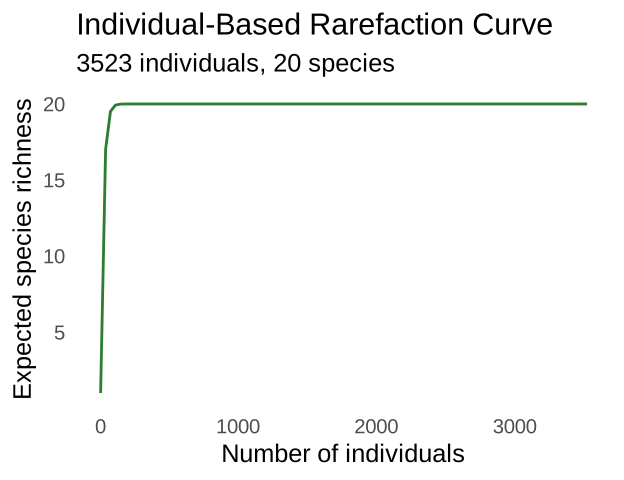
Rarefaction at higher orders down-weights the rare species. Passing
q = 1 and q = 2 returns the Shannon and
Simpson effective numbers, which saturate faster because they are
governed by the common species rather than the long tail.
rarefy() accepts any non-negative order; orders 0, 1, and 2
use exact estimators while other orders report the Hill number of order
q of the sampled composition.
rare_q1 <- rarefy(species, q = 1)
rare_q2 <- rarefy(species, q = 2)
c(q0 = max(rare$expected), q1 = max(rare_q1$expected), q2 = max(rare_q2$expected))
#>       q0       q1       q2
#> 20.00000 19.95649 19.91239
rare_q3 <- rarefy(species, q = 3)
rare_half <- rarefy(species, q = 0.5)
c(q0.5 = max(rare_half$expected), q3 = max(rare_q3$expected))
#>     q0.5       q3
#> 19.97833 19.86778
Analytical sample-based alternatives
Rarefaction can also be sample-based: instead of subsampling
individuals, the unit subsampled is the site. spacc
provides three analytical curves over sites that need no simulation.
mao_tau() is the exact expected sample-based rarefaction of
Colwell et al. (2004); it binarizes the matrix and returns a data frame
with sites, expected, sd, and
analytical 95 percent lower/upper bounds.
coleman() returns the Coleman et al. (1982) expectation
with columns sites, expected, sd.
collector() returns the species count in data order, with
columns sites, species, which traces how the
actual survey accumulated species rather than a randomized
expectation.
mt <- mao_tau(species)
cm <- coleman(species)
cl <- collector(species)
head(mt, 3)
#>   sites expected        sd     lower    upper
#> 1     1 16.88333 10.575273 -3.844201 37.61087
#> 2     2 19.52655  4.270861 11.155666 27.89744
#> 3     3 19.93016  1.648929 16.698256 23.16206
Plotting the three together shows that the randomized expectations
from mao_tau() and coleman() lie close to each
other, while the collector’s curve fluctuates around them because it
follows the arbitrary order of the rows. The Mao Tau band gives the
analytical uncertainty without any bootstrap.
df <- rbind(
  data.frame(sites = mt$sites, S = mt$expected, kind = "Mao Tau"),
  data.frame(sites = cm$sites, S = cm$expected, kind = "Coleman"),
  data.frame(sites = cl$sites, S = cl$species,  kind = "Collector")
)
ggplot2::ggplot(df, ggplot2::aes(sites, S, color = kind)) +
  ggplot2::geom_line(linewidth = 0.9) +
  ggplot2::labs(x = "Sites", y = "Species", color = NULL) +
  ggplot2::theme_minimal(base_size = 17) + transparent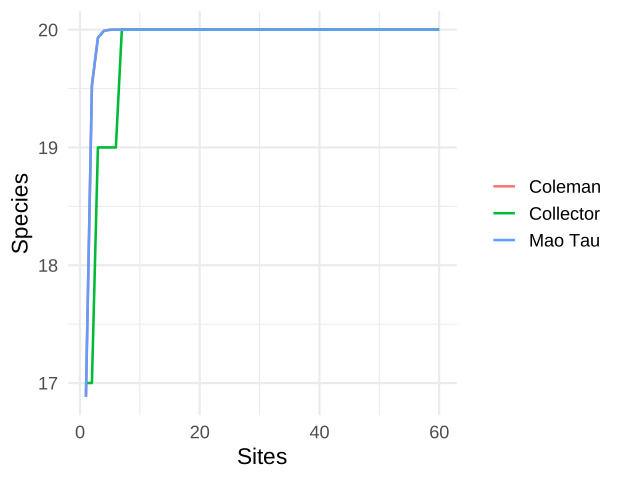
The Mao Tau and Coleman expectations are the sample-based analogue of
Hurlbert’s individual-based curve. They standardize on number of sites;
rarefy() standardizes on number of individuals. Which axis
matters depends on whether effort varies through plot count or through
depth of sampling within plots.
Coverage-based standardization
spaccCoverage() accumulates sites spatially while
tracking the Chao-Jost coverage at each step, across many random
starting seeds. The default estimator is "chao"; a
"chiu" option uses incidence frequencies and is recommended
when the sampling units are plots rather than independent individuals.
The result is a spacc_coverage object holding
n_seeds by n_sites matrices of richness,
individuals, and coverage.
cov_result <- spaccCoverage(species, coords, n_seeds = 30, progress = FALSE)
print(cov_result)
#> spacc coverage (Chao-Jost 2012): 60 sites, 20 species, 30 seeds
#> Mean final coverage: 100.0%
#> Mean final richness: 20.0 species
plot(cov_result) + transparent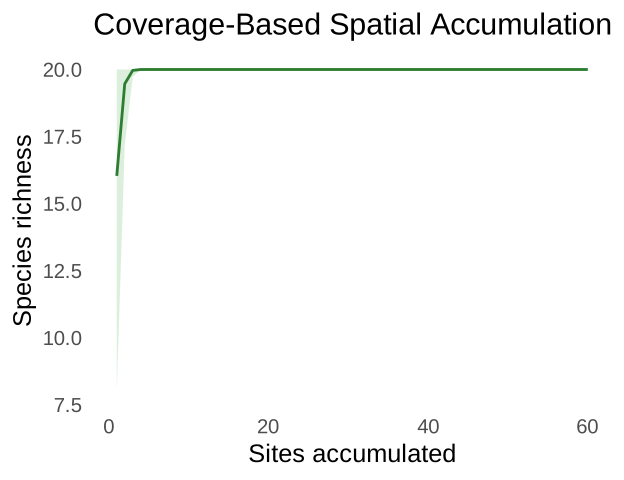
Interpolation at fixed coverage
interpolateCoverage() reads richness off each seed’s
curve at the requested coverage levels by linear interpolation. The
return is a data frame with one row per seed and one column per target,
so the spread across rows is the across-seed uncertainty introduced by
the choice of starting point.
interp <- interpolateCoverage(cov_result, target = c(0.90, 0.95, 0.99))
round(colMeans(interp), 2)
#>   C90   C95   C99
#> 18.70 19.20 19.77
round(apply(interp, 2, sd), 3)
#>   C90   C95   C99
#> 1.323 0.770 0.315
The across-seed standard deviation widens toward higher coverage targets, because those targets sit near or beyond the end of some seeds’ curves where interpolation has less support. The mean richness at 90 percent coverage is the fair point estimate; the column standard deviation is its seed-induced uncertainty.
Each seed is a different spatial path through the sites, starting
from a different point and accumulating neighbours in a different order.
Because the sites are spatially structured, the order in which they are
added changes the coverage reached at each step, and so two seeds can
hit 90 percent coverage at different richness values. Averaging over
seeds marginalizes out the arbitrary choice of starting point, and the
spread of the per-seed values is the honest uncertainty that choice
introduces. Reporting only the mean would hide that spread; reporting
per-seed values exposes it, which is why
interpolateCoverage() returns the full matrix rather than a
collapsed summary.
Extrapolation beyond observed
When a target coverage exceeds the coverage a seed reached,
interpolation is impossible. Every seed ends with the same pooled sample
of all sites, and extrapolateCoverage() extrapolates that
sample with the Chao et al. (2014) estimators, towards the Chao1
asymptote for \(q = 0\). A
spacc_coverage object carries richness only; for \(q = 1\) and \(q =
2\), pass a spaccHillCoverage() object, whose
extrapolation approaches the Shannon and Simpson asymptotes. The
returned spacc_coverage_ext object reports the observed
coverage and richness alongside the extrapolated values.
extrap <- extrapolateCoverage(cov_result, target_coverage = c(0.95, 0.99), q = 0)
print(extrap)
#> Coverage-based extrapolation
#> --------------------------------
#> Diversity order: q = 0
#> Observed coverage: 100.0%
#> Observed richness: 20.0
#>
#> Extrapolated richness:
#>   C=95%: 19.2 (+/- 0.8)
#>   C=99%: 19.8 (+/- 0.3)
summary(extrap)
#>     target_coverage mean_richness       sd    lower upper
#> C95            0.95      19.20405 0.769666 17.82051    20
#> C99            0.99      19.76802 0.314623 19.00000    20
plot(extrap) + transparent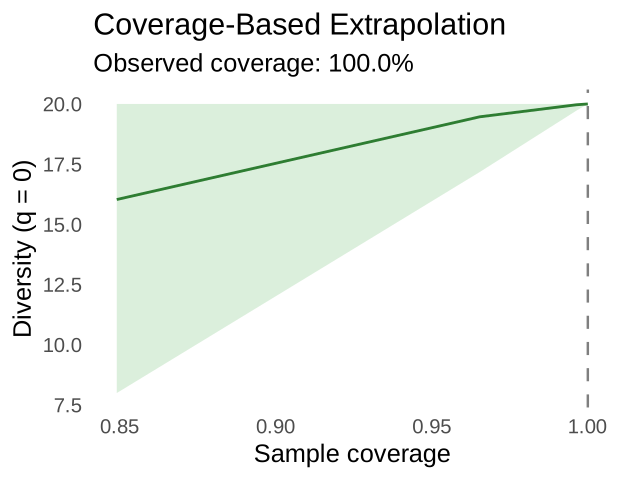
Extrapolation is reliable only over a limited range past the observed coverage. The dashed reference line marks the observed coverage; the orange points beyond it are model-based projections whose uncertainty grows with distance from the data. Targets far past the observed maximum should be read as informed extrapolation, not measurement.
Hill numbers with coverage
spaccHillCoverage() tracks Hill numbers for several
orders and coverage at the same time, so the three diversity orders can
be standardized to one completeness. Supplying
target_coverage adds a standardized component
holding each order’s value interpolated to that coverage for every
seed.
hc <- spaccHillCoverage(species, coords, q = c(0, 1, 2),
                        target_coverage = 0.9,
                        n_seeds = 20, progress = FALSE)
print(hc)
#> spacc Hill + Coverage: 60 sites, 20 species, 20 seeds
#> Orders (q): 0, 1, 2
#> Mean final coverage: 1.000
#> Target coverage: 0.9
The standardized list gives the seed-averaged effective
number of species at 90 percent coverage for each order. Richness (\(q = 0\)) is highest and most seed-variable,
while \(q = 2\) is lowest and most
stable, the expected ordering \({}^{0}D \ge
{}^{1}D \ge {}^{2}D\).
sapply(hc$standardized, mean)
#>     q0.0     q1.0     q2.0
#> 18.26128 16.36272 15.13016
plot(hc, xaxis = "coverage") + transparent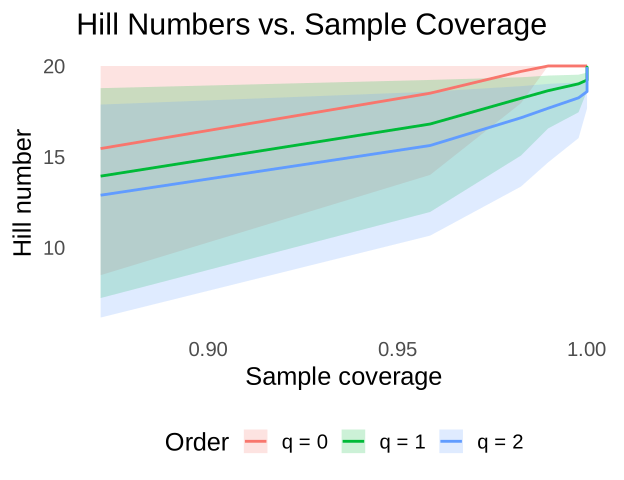
Reading diversity against coverage rather than against sites puts all three curves on a completeness axis. The vertical gap between the \(q = 0\) and \(q = 2\) curves at a fixed coverage measures the unevenness of the community: a wide gap means a few dominant species and a long rare tail.
Standardizing all three orders to a single coverage is what makes the comparison across \(q\) fair. If each order were read at the end of its own accumulation, the orders would sit at slightly different completeness levels and the contrast between them would mix a real diversity difference with a residual effort difference. Fixing coverage first removes that confound, leaving the spacing between \({}^{0}D\), \({}^{1}D\), and \({}^{2}D\) as a clean signal of evenness. The same machinery scales to comparing several communities: standardize every community to the same coverage, then read off the diversity profile for each, and the profiles are directly comparable because they share both the completeness and the set of orders.
Spatial subsampling
Spatial autocorrelation inflates apparent accumulation when nearby
sites hold similar species. Two tools reduce it.
subsample() returns site indices to keep under a grid,
random, or thinning rule; the grid method overlays cells of a chosen
size and retains one random site per cell, which spreads the retained
sites out. spatialRarefaction() instead runs
distance-weighted permutations and returns the spatially constrained
expectation directly.
set.seed(7)
keep <- subsample(coords, method = "grid", cell_size = 0.2, seed = 7)
length(keep)
#> [1] 23
A grid at cell size 0.2 over the unit square thins 60 sites down to roughly the number of occupied cells. Comparing the accumulation curve on the thinned set against the full set shows how much of the original rise came from spatially redundant neighbours.
full  <- spacc(species, coords, n_seeds = 30, progress = FALSE)
thin  <- spacc(species[keep, ], coords[keep, ], n_seeds = 30, progress = FALSE)
df_full <- transform(as.data.frame(full), set = "Full")
df_thin <- transform(as.data.frame(thin), set = "Thinned (grid)")
ggplot2::ggplot(rbind(df_full, df_thin),
                ggplot2::aes(sites, mean, color = set)) +
  ggplot2::geom_line(linewidth = 1) +
  ggplot2::labs(x = "Sites", y = "Species", color = NULL) +
  ggplot2::theme_minimal(base_size = 17) + transparent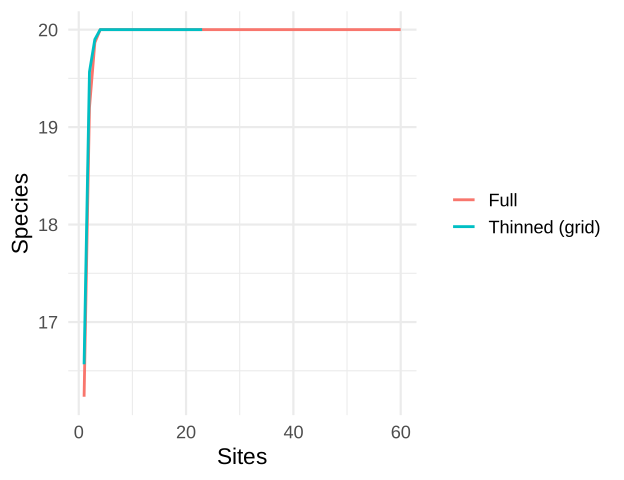
The thinned curve reaches a similar asymptote with fewer sites, since
the discarded sites were spatial near-duplicates that added little new
information. spatialRarefaction() gives the same correction
analytically, returning a data frame with sites,
mean, sd, and quantile bounds from
distance-weighted draws.
sr <- spatialRarefaction(species, coords, n_perm = 50)
tail(sr[, c("sites", "mean", "lower", "upper")], 2)
#>    sites mean lower upper
#> 59    59   20    20    20
#> 60    60   20    20    20
Comparison on the same data
The three standardizations can disagree about which sites are more diverse, because they hold different quantities constant. The clearest demonstration uses the effort tiers from the simulation. The low-effort and high-effort tiers share the same 20-species community but differ fivefold in individuals per site. Raw richness, richness at matched individuals, and richness at matched coverage tell three different stories.
lo <- species[lambdas == 1, ]
hi <- species[lambdas == 5, ]
raw <- c(low = sum(colSums(lo) > 0), high = sum(colSums(hi) > 0))
raw
#>  low high
#>   20   20
Matched effort uses individual-based rarefaction at a common subsample size set by the smaller pool. Each tier is rarefied to the same number of individuals, so the comparison no longer rewards the deeper-sampled tier.
n_match <- min(sum(lo), sum(hi))
S_lo <- rarefy(lo, n_individuals = n_match)$expected
S_hi <- rarefy(hi, n_individuals = n_match)$expected
c(low = round(S_lo, 1), high = round(S_hi, 1), n = n_match)
#>  low high    n
#>   20   20  369
Matched coverage uses coverage-based standardization at a common completeness. The two tiers are interpolated to the same coverage so the comparison rewards equal proportional representation rather than equal individuals.
co_lo <- spaccCoverage(lo, coords[lambdas == 1, ], n_seeds = 20, progress = FALSE)
co_hi <- spaccCoverage(hi, coords[lambdas == 5, ], n_seeds = 20, progress = FALSE)
S_lo_c <- mean(interpolateCoverage(co_lo, target = 0.9)[, 1])
S_hi_c <- mean(interpolateCoverage(co_hi, target = 0.9)[, 1])
c(low = round(S_lo_c, 1), high = round(S_hi_c, 1))
#>  low high
#> 15.6 20.0
Collecting the three views into one table makes the shift in conclusion explicit. Raw counts favour the high-effort tier by the largest margin; matched effort and matched coverage shrink or reverse that margin, because both tiers draw from the same community and the difference was an artefact of sampling depth.
data.frame(
  standardization = c("Raw richness", "Matched individuals", "Matched coverage (0.90)"),
  low  = c(raw["low"],  round(S_lo, 1), round(S_lo_c, 1)),
  high = c(raw["high"], round(S_hi, 1), round(S_hi_c, 1)),
  row.names = NULL
)
#>           standardization  low high
#> 1            Raw richness 20.0   20
#> 2     Matched individuals 20.0   20
#> 3 Matched coverage (0.90) 15.6   20
The lesson is that a richness comparison is only as meaningful as the quantity held constant. Reporting raw richness across uneven samples measures effort; reporting it at matched effort or matched coverage measures the community. When the standardized margins are small, the apparent difference in the raw data was sampling, not biology.
The three rows answer three different questions about the same two tiers. The raw row asks how many species were recorded, which is a statement about the survey, not the community. The matched-individuals row asks how many species each tier would show if both had been sampled to the same depth, which removes the fivefold difference in effort and brings the two tiers close together. The matched-coverage row asks how many species each tier holds at equal completeness, which can favour the low-effort tier if its smaller sample happened to be more even. Since both tiers were generated from the same 20-species pool, the correct answer is that they are equally diverse, and the standardized rows recover that far better than the raw row. In field data the truth is unknown, so the discipline is to report the standardized comparison and to state which quantity was held constant, rather than letting the reader assume raw counts are comparable.
A short note on which standardization to trust when they disagree. Matched individuals and matched coverage will not always agree, and the difference is informative rather than a contradiction. When they diverge, the tiers differ in evenness as well as in effort: equalizing individuals leaves the more even community at higher coverage, while equalizing coverage gives it fewer individuals. Coverage is usually the more defensible target for comparing communities that differ in evenness, because equal completeness is closer to the ecological question of how much of each community has been seen. Matched individuals remains the right target when the comparison is explicitly about a fixed sampling budget rather than about completeness.
Practical guidance
Standardization choices come down to what varies across the samples being compared and whether the data carry the abundance information coverage needs.
Rules of thumb.
- Target coverage of 0.90 to 0.95 for most comparisons. Below 0.85 the rare tail is too poorly sampled for the coverage estimate to be stable; at 0.99 the curves are near their asymptote and the comparison adds little over a richness estimator.
- Keep at least 30 to 50 individuals per site before trusting an individual-based rarefaction; below that the curve is dominated by the first few draws and the bootstrap interval is wide.
- Limit extrapolation to roughly 2 to 3 times the observed sample size, or to coverage no more than a few points past the observed maximum. Beyond that the Chao asymptotics extrapolate the rare tail well past the data.
- Use at least 20 to 30 seeds in
spaccCoverage()andspaccHillCoverage()so the across-seed standard deviation is a usable uncertainty estimate rather than noise from too few starting points. - Down-weight the rare tail with \(q = 1\) or \(q = 2\) when singletons are suspected to be identification errors; richness (\(q = 0\)) is the order most sensitive to that noise.
Minimum sample size. Individual-based rarefaction
needs enough individuals that the curve has begun to flatten; 30 to 50
per site is a working floor, and comparisons should rarefy down to the
smallest pool, not up. Coverage-based methods need enough singletons and
doubletons to estimate \(f_1\) and
\(f_2\); a sample with fewer than about
10 species or no doubletons gives an unstable coverage estimate.
Sample-based curves (mao_tau, coleman) need at
least 10 to 15 sites before the expectation and its variance are
meaningful.
Decision table.
| Situation | Recommended method | Why |
|---|---|---|
| Sites differ in number of individuals, abundances available | Coverage-based (spaccCoverage,
interpolateCoverage) |
Compares at equal completeness |
| Effort varies but only counts of individuals matter | Individual-based (rarefy) |
Hurlbert expectation at matched \(n\) |
| Effort varies through plot count, presence/absence only | Sample-based (mao_tau, coleman) |
Standardizes on number of sites |
| Need several diversity orders at once | spaccHillCoverage |
Tracks \(q = 0, 1, 2\) and coverage together |
| Nearby sites are spatially redundant |
subsample(method = "grid"),
spatialRarefaction
|
Reduces autocorrelation inflation |
| Want richness past observed completeness | extrapolateCoverage |
Chao asymptotic projection |
When not to use coverage-based methods. Coverage is defined through \(f_1\), \(f_2\), and \(N\), so it requires genuine abundance counts. Presence/absence data have no singletons or doubletons in the abundance sense, and the Chao-Jost estimator cannot be formed; sample-based rarefaction on sites is the correct tool there. Coverage is also unreliable when the sample is tiny or has no doubletons, since the denominator \((N-1) f_1 + 2 f_2\) then rests on a single frequency class. And when sampling effort is already equal across sites, standardization is unnecessary; raw richness is directly comparable and adding a rarefaction step only discards information.
References
- Chao, A. & Jost, L. (2012). Coverage-based rarefaction and extrapolation: standardizing samples by completeness rather than size. Ecology, 93, 2533-2547.
- Chao, A., Gotelli, N.J., Hsieh, T.C., Sander, E.L., Ma, K.H., Colwell, R.K. & Ellison, A.M. (2014). Rarefaction and extrapolation with Hill numbers. Ecological Monographs, 84, 45-67.
- Coleman, B.D., Mares, M.A., Willig, M.R. & Hsieh, Y.H. (1982). Randomness, area, and species richness. Ecology, 63, 1121-1133.
- Colwell, R.K., Mao, C.X. & Chang, J. (2004). Interpolating, extrapolating, and comparing incidence-based species accumulation curves. Ecology, 85, 2717-2727.
- Hurlbert, S.H. (1971). The nonconcept of species diversity: a critique and alternative parameters. Ecology, 52, 577-586.